
An Intelligible, Sincere Guide to all Owners of Cats.
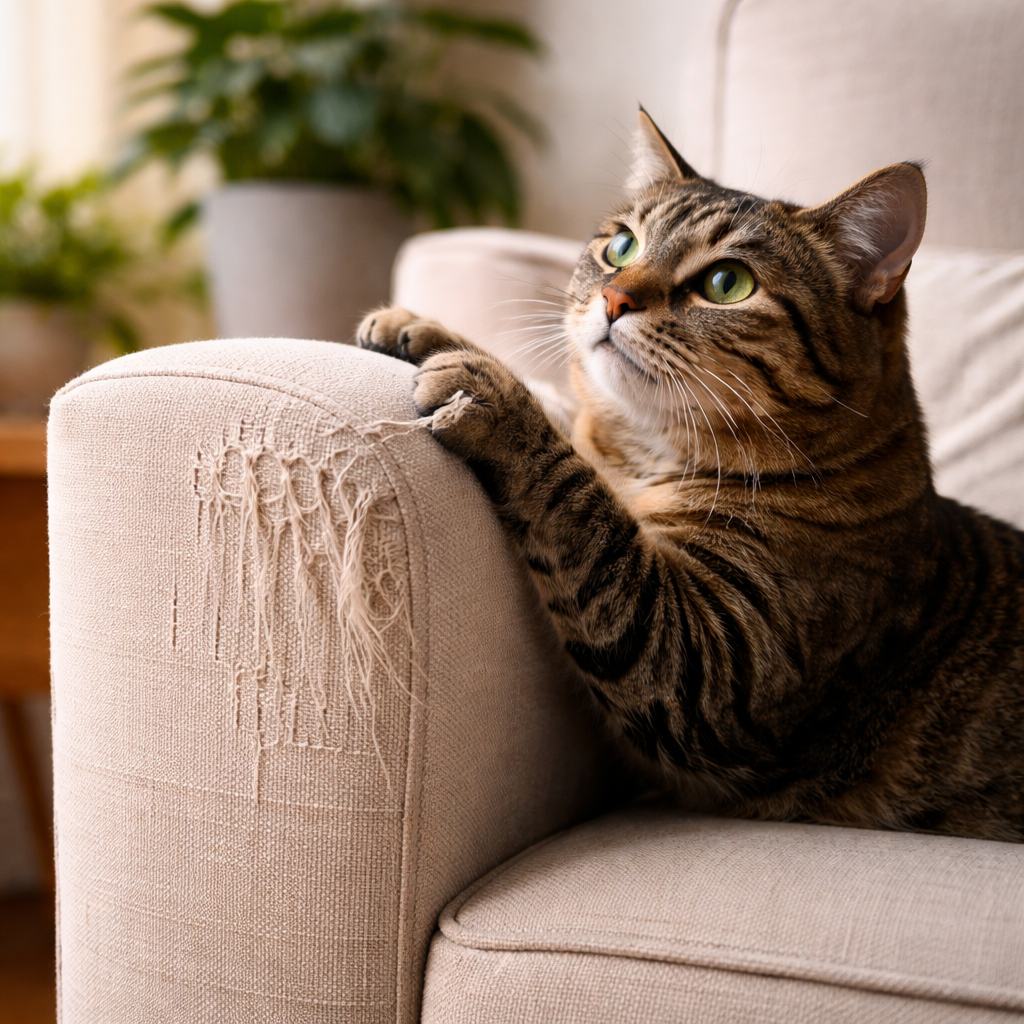
It is personal to scratch the furniture. It is normally the initial emotion. You buy a couch. You attempt to beautify the aesthetic appearance of your living room. Then your cat comes and scratches the armrest, and digs its claws in there, as if it was meant to be scratched.
It is frustrating. It is confusing. And it usually results into a single misunderstanding; the assumption that your cat is acting out.
As soon as you know the reason behind cats scratching, it will be much less dramatic and much more successful to stop the damage.
Then we shall pull this in and learn it in a way that is not punitive, mythical and not idealistic.
Now, here is the plain question which you must ask yourself:
Find out whether you are attempting to prevent the cat scratching completely, or attempting to protect your furniture?
That difference is more than you think.
Scratching for Cats is Not an option.
This is the underlying fact that most individuals do not listen to sufficiently, scratching is a biological need of cats.
Cats scratch to;
- Take away dead layers of their claws.
- Tensile muscles along the back, shoulders and legs.
- Making an attempt to mark its territory with scent glands in their paws.
- Get rid of emotional pressure, excitement or stress.
Scratching helps in physical and emotional balance. A cat, which is unable to scratch correctly, tends to become nervous, irritated, or to do it in some other way.
So let’s be very clear.
What we are now talking about has nothing to do with training your cat not to scratch.You are training your cat on how to scratch the places of your choosing. Such attitude transformation transforms everything.
The Reason Furniture is the Target.
The cats do not select furniture at random. They select it in a strategic manner. The majority of the furniture possesses the same characteristics that cats prefer in a scratching place:
- It is stable and does not move
- It will permit a complete vertical stretch.
- It is situated in socially significant regions.
- It has a satisfying texture
Every box is checked by a couch arm, chair leg or bed frame. And therefore when a cat refuses to play with a little, wiggly scratching post in a corner, it is not obstinacy. That is just logic.
This is a question that you should ask yourself:
As a cat, would I trust my scratching post, if it made any motion every time I leaned against it?
The Great Reality: Scratching Posts Have a Worse Time than Cats.
Bad cats do not cause most of the scratching problems. They are brought about by poor scratching arrangements.
An adequate scratching alternative should be of very specific standards. Size and Stability Matter
A vertical scratching post must be tall enough to allow a cat to stretch to full height and this is normally 28 to 32 inch minimum. It must also be heavy or firmly pegged.
When the post is wobbly, cats will soon quit scratching it.
Material Matters Too
Various cats choose the comfort of various textures of surfaces:
- a rope textured material to enhance stiffness in resistant claws.
- Paper-like substances for the pleasure of tearing.
- Rough fabric for grip
What the cat already tells you is their preference with what they scratch. Even the furniture itself is a hint.
So pause and observe.
Do you know whether your cat prefers to scratch in a straight or a horizontal direction or both directions?
Placement is Behavioral Science but not Decoration.
It is at this point that most owners fail accidentally. The cats scratch in the places that are emotionally important, rather than convenient to look at. There are also places that your cat might take a liking to scratch and they are:
- Near sleeping spots
- Along daily walking paths
- Close to entrances
- In shared family spaces
A scratching post in a corner that is hidden may be sure to be neglected.
Rather put scratching posts:
- Right next to battered furniture.
- Position such scratching posts around places that your cat is already visiting.
- In rooms where individuals socialize.
Once your cat has become used to scratching the scratching post every time, the post can be relocated over time. An abrupt withdrawal, however, tends to work against you.Here is a nice tip to know : Scratching posts must not be used to compete with each other.
Lessening the Attractiveness of Furniture without causing Fear.
Having furniture scratching is best stopped when you make contrast rather than conflict.
Cats do not like some textures and sensations. This can be used safely by application:
- Targeted areas with double-sided tape.
- Plastic furniture guards or shields.
- Commercial cat deterring sprays.
These do not punish the cat. They only render the surface less pleasing. What you should avoid:
- Yelling
- Hitting
- Spraying water from bottles on the cat
Fear destroys trust and tends to heighten anxiety scratching.
So are you going to attempt to train your cat to do something better, or are you merely letting out your frustration?
Only one of them has long-term effectiveness.
The Positive Reasoning Does Work With Cats.
This surprises many people.
Cats are also subject to positive reinforcement provided that the reinforcement is in line with their instincts.
as an example, When your cat scratches on the right scratching material:
- Offer calm verbal praise
- Toss a small treat nearby
- Attempt to begin playing with your cat around the scratching post.
- You must also attempt to spray a bit of catnip every now and again.
You are not enforcing obedience, you are supporting a decision for and by the cat.
The behavior that is rewarding is repeated. That is true of cats no less than human beings.
Claw Maintenance is one of the solutions which you can actually give a go.
Regular claw trimming it is good to practice Regular claw trimming – you should trim your nails every 2 to 4 weeks – this is a simple thing that can save much damage.
Shorter claws:
- Cause less tearing
- Get caught less easily
- Enhance redirection.
Trimming does not prevent scratching but it will decrease the destruction during the training process.
In case it is daunting when you are trimming, a groomer or a veterinarian can show you how to do it safely. When learnt it becomes habitual.
Nail Caps: A handy or a temporary way out?
the Soft nail caps may be useful under the following circumstances:
- Rental homes
- Temporary furniture insurance.
- Transitional intervals during training.
They need upkeep and correct usage, however, when used the right way, they can minimize harm, and behavior modification will become permanent.
Imagine nail caps as a stopover, and not a place.
What You Should Never Do
There are those methods which are harmful in the long run and should be avoided at all costs.
- Declawing destroys bone and usually results in chronic pain.
- Training based on punishment enhances fear and stress.
- Coercion to physical restraint destroys trust.
Cats can live and develop in a safe and predictable environment. Either of them will result in increased behavioral problems, not reduced.
When Scratching is a cat behavior indicating stress.
When scratching suddenly develops, it is a sign that the person is in distress. Common triggers include:
- Moving homes
- New pets or people
- Schedule changes
- Environmental noise
- Reduced play or stimulation
Scratching in such situations is a form of coping. The stress-induced scratching can be decreased with the help of environmental enrichment, regular routines, interactive play, and pheromone diffusers.
The Reality Most Owners Have to Accept.
It does not happen overnight to prevent furniture scratching. It requires:
- Observation
- Consistency
- Patience
- Never fail to treat the feline instincts of your cat with Respect.
Cats can be very adaptable, smart and sensitive when their needs are appropriately addressed.
Furniture becomes unattractive after meeting physical and emotional needs with scratching surfaces.
Final thoughts
Scratching is not rebellion.
It is self-regulation, maintenance and communication.
Fighting the behavior will never get your home any calmer, however, when you begin to lead it, your home will be a gentler place and your relationship with your cat will be better.
And therewith is the last question to be left with you:
Am I treating my cat biologically, that is, am I treating them in a way that they can scratch, or am I asking them to act like something I am not?
Cats are able to perceive the difference and effects when you take care of your cat out of a place of informed knowledge.